Jack Tatum made Wild Nothing’s first album, Gemini, on a laptop in his dorm room at Virginia Tech. For the second he got a producer, a studio and a deadline. Nocturne came out on Captured Tracks on August 28, 2012, a day after Bella Union released it in the UK, and Tatum stated the aim plainly: “My only real ambition for this album was to make a polished pop record.”
Most of the songs were written in Savannah, Georgia, where Tatum spent a year after college because it was cheap and he had friends there. He has said he felt “very connected to the nighttime” in that city. By the time he was ready to record he had moved to Brooklyn, and the producer he had been waiting for, Nicolas Vernhes, turned out to work in the same neighbourhood. They recorded and mixed the album at Vernhes’s studio, Rare Book Room, in three weeks, a limit Tatum credited with stopping him from overthinking. He brought half-finished songs and completed them there. His touring band stayed out of the sessions: Tatum played everything except the drums and the strings, with Jeff Curtin drumming on eight songs and Michael Skattum on “Midnight Song”.
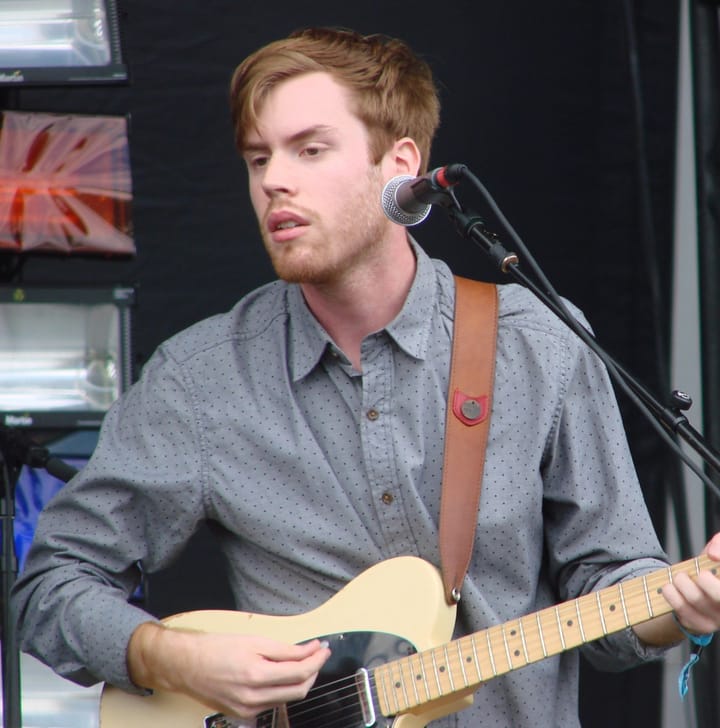
The studio changed the detail more than the design. Tatum said the biggest gain was having someone knowledgeable to bounce ideas off, and that he never wanted a wholly different sound from Gemini. Pitchfork counted the upgrades as basic ones: live strings, a human drummer, better microphones. The strings appear on one song. “Shadow”, the first track released, in June 2012, has a quartet arranged and conducted by Ben Talmi, something Tatum said he could never have done before, and Pitchfork pointed to a four-note motif doubled on lead guitar and violin. “Paradise”, the other lead single and the longest track at five and a half minutes, breaks off from what Pitchfork called downer-disco for an ambient build-up. Its video, directed by Matt Amato, stars Michelle Williams.
Tatum built the album around the title track, which he called its centrepiece before it had that name. He writes the vocal melody first and fits the words in afterwards, and he has said the vocals work “almost as another instrument”. The BBC traced a thread of night and dreams through the titles and the lyrics. “Through the Grass” sets reverb against a Spanish-style guitar that both the BBC and PopMatters picked out. “Only Heather” is the plainest love song here and the one that split critics most: musicOMH found it gorgeously uncomplicated, PopMatters called it the weakest track. Tatum’s own favourite was the closer, “Rheya”, for its subtle build.
Pitchfork made Nocturne Best New Music with an 8.3 and called Tatum one of the best songwriters in his field. Under the Radar went further and named it the best album of 2012. Metacritic’s average came to 75 from 27 reviews. The doubts were about familiarity and words. NME, at 7 out of 10, found it gorgeous but too predictable in a crowded field of similar records, and Drowned in Sound heard the second half turn formulaic. Even Pitchfork thought the lyrics lagged behind the melodies.
In 2013 Tatum said he had thought “way too hard” about the record and that it was missing something. The worry fits the lyrics and little else. Three weeks in a Brooklyn studio, one string quartet and a drummer were enough to show what the haze on Gemini had covered: melodies that keep their shape when every part can be heard. Nocturne is the record where Wild Nothing stopped sounding like a dorm-room project, and it opens with “Shadow”, the best case for that change in just over four minutes.
Watch and listen
Players only load when you press play. Their providers may set cookies.


