Portugal. The Man had put out roughly an album a year since 2006, then took four years over the next one. Woodstock, their eighth, came out on Atlantic on 16 June 2017, and it is the record’s second version. The first, Gloomin + Doomin, was close to finished when the band threw it away. What turned them around was a visit home to Wasilla, Alaska, where John Gourley’s father asked what was taking so long and showed them a ticket for the first day of the 1969 festival, long thought lost.
The discarded sessions began in November 2014 with Mike D of the Beastie Boys, at Shangri-La in Malibu and in his home studio, and the songs kept multiplying. “We did five or six versions of every song,” the bassist Zach Carothers, who has since left the band, told the Charleston City Paper. Meanwhile the 2016 presidential campaign was turning uglier, and Gourley and Carothers decided the material sounded too polished for the moment, Rolling Stone reported; the guitarist Eric Howk said the ticket met a political climate none of the old songs addressed. So the band kept a few fragments and started again with John Hill, Danger Mouse, Mike D and Casey Bates, the one producer, Atlantic noted, on every record since the first.
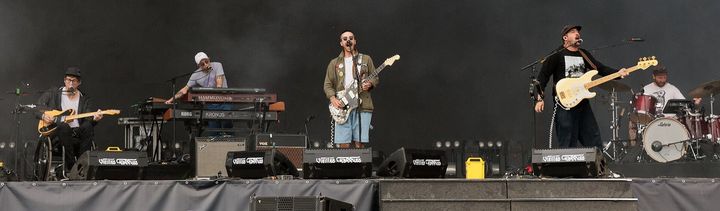
The song that carried the album came out of a break. Gourley was mixing “Live in the Moment” at Hill’s studio when he stepped into a side room and played a Motown-style bass line, and Asa Taccone of Electric Guest, there on other work, asked to record it. The melody of the Marvelettes’ “Please Mr. Postman” went in as a placeholder and stayed, so its writers share the credit. “The whole thing was just 45 minutes,” Gourley told Time. He told Billboard the lyric came from a George Carlin line about distrusting politicians and from a 2016 race that split voters into Team Trump and Team Hillary. An interactive version of the video, made with Wieden+Kennedy, hid links to a White House phone line, a guide to protesters’ rights and donation pages for Planned Parenthood and the ACLU.
The rest is shared among the producers. Danger Mouse, back from Evil Friends (2013), made “Number One”, “So Young” and “Mr Lonely”. “Number One” opens with Richie Havens’s “Freedom”, from his set at the 1969 festival, and Son Little sings over it; “Mr Lonely” has Fatlip of the Pharcyde and a clip from Portlandia. Hill produced five songs, two with Stint, and “Rich Friends” interpolates Autolux’s “Turnstile Blues”. Mike D has additional credits on the first two tracks but is the main producer of only “Noise Pollution”, the closer and the first song released, in December 2016, made with Gourley and featuring the actor Mary Elizabeth Winstead and the band’s Zoe Manville.
Reviews were mostly warm, rarely more. PopMatters (8/10) found it more instantly likeable than Evil Friends, though shallower in places, and placed “Number One” among the band’s best songs. AllMusic’s Thom Jurek counted nine engineers and more than 20 guests and called it “an enormous-sounding, splashy album”. Pitchfork’s Evan Rytlewski (6.6) allowed that it worked as the commercial record Atlantic had been waiting for, but found the topical writing clumsy, the slogans of “Noise Pollution” above all. The A.V. Club (C+) preferred the songs that sound least like the old band and worried it had traded away what set it apart. “Feel It Still” reached No. 4 on the Billboard Hot 100, the band’s first entry on the chart, and won the Grammy for Best Pop Duo/Group Performance in January 2018.
Boiling four years of work and, by Gourley’s count, 60 songs down to ten tracks and under 39 minutes was the record’s best decision. Everyone brought in has a specific job: Havens’s voice opens and closes the first song, Son Little sings against it, Fatlip raps on “Mr Lonely”, Winstead and Manville carry the closer, and Taccone, who happened to be in the side room, turned a bass line played on a break into the hit. The politics come as pop, catchy first and pointed second, which Pitchfork found thin and which is also why they travelled: the ACLU link sat inside the video for a top-five single. Some lines are slogans, and a few choruses aim at radio too squarely. Gourley’s father kept a ticket for the first day of the 1969 festival; the album opens with the voice of the man who played first that day.
Watch and listen
Players only load when you press play. Their providers may set cookies.


