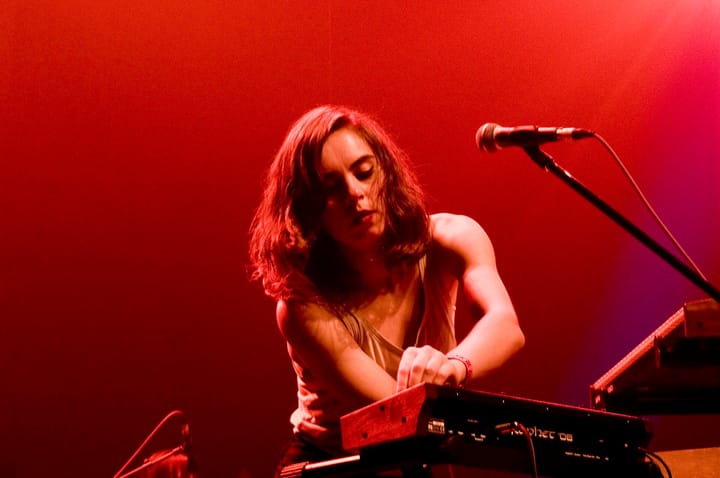
Ejecta began with two touring musicians who met on the road in 2009: Leanne Macomber, who played keyboards in Neon Indian’s live band, and Joel Ford, then of Tigercity and one half of Ford & Lopatin. Dominae, their debut, came out in November 2013 as the first release on Driftless Recordings, a label Ford had just started, with Happy Death handling the UK. Ejecta is a volcanology term for the dust that settles after an eruption, and Macomber plays Ejecta as a character, always shown nude so that she carries no signs of class or culture. The sleeve frames the record just as clearly: Macomber wrote all ten songs, and Ford shares the credit on two.
Most of them started as her demos, some of them old. “Mistress”, the opener, was seven years old by the time it came out, and “Tempest” was written as the album was being finished. Ford’s first move was to rework her demo of “Silver”; then he sent her a piece of music of his own, which became “It’s Only Love”. The sessions began in the summer of 2012 and, by Ford’s count, took 14 months across five “studios”, from bedrooms and laptops to proper rooms, with expensive gear and broken equipment. They started out in different cities, trading files, and did most of the tracking and all of the mixing in Brooklyn and Manhattan. On her first day in a real studio Macomber cut five of the ten vocals, most of them in one take, Ford says. He also lost one session’s files along the way and had to rebuild it.
“It’s Only Love” is Ford’s music. Macomber hummed along to it for months before the words came, and they are about a man who wouldn’t commit, which makes the title sarcastic. “Jeremiah”, the other song he co-wrote, is the one she remembers the two of them writing together from start to finish; Pitchfork heard disco in it, and The 405 noted its long instrumental stretch. “Silver” is an invention. She wrote it for a girl who was train-hopping through her small town in Texas, imagining years of love that ended, when the girl was only passing through. “Small Town Girl” turns the record dark, a revenge fantasy over a hard drumbeat in which she wishes a former lover dead and buried. Macomber calls it “the darkest curse I’ve ever given someone”.
She has described the whole album as ripped from her diary: songs about death, love and struggling with adulthood, which she says cover her twenties. “Eleanor Lye”, the eighth track, is about the death of a close friend, and in 2014 it got a video directed by Allie Avital Tsypin that opens on a short poem about lava freezing and new earth forming, then follows Ejecta learning to move a body she has never had before. “Tempest” goes the other way. Ford had wanted something minimal to set against the busier tracks, and Macomber wrote it in tears, just after running into an ex. It runs 2:13 and stops abruptly, and they kept it even though they thought it was an odd fit.
Most reviews were warm. Polari Magazine gave it five stars, The 405 an 8 and The Skinny four stars; Pitchfork and PopMatters both landed on 7, and Gorilla vs. Bear put it sixth among its albums of 2013. The doubters went after the retro frame. Loud and Quiet gave it 4 out of 10, comparing the duo to Yazoo and arguing that La Roux and Little Boots had already used up this kind of nostalgia in 2009, and Mojo gave it three stars. Where the positive reviews agreed was on Macomber. PopMatters heard her voice, heavy with echo, running the show, and Pitchfork found the sound familiar but the confessions convincing.
Ford’s polish is real, and the songs need it, but Dominae belongs to Macomber. The songs are hers, several of them older than the band, and the character, the title and the artwork all point back at her. That is why it works best when it is saddest. The disco touches in “Jeremiah” and “Afraid of the Dark” give it a pulse without turning it into a club record, and its peak is “Eleanor Lye”, a song about losing a friend inside a record about being reborn. It was made in stolen hours, around day jobs, in five different rooms. Seven years after Macomber wrote “Mistress”, the song finally had an album to open.
Watch and listen
Players only load when you press play. Their providers may set cookies.


