Phil Elverum took a year off touring to make Clear Moon. With a friend he rented a building in Anacortes, Washington, that had once been a Catholic church and later a sail-making loft, and from October 2010 to January 2012 he walked between his house and that studio, the Unknown, almost every day, recording everything himself on analog equipment. Clear Moon came out on his own label, P.W. Elverum & Sun, in May 2012. Ocean Roar, made in the same sessions, followed at the end of the summer.
The sessions began with no plan, and a lot of what he recorded was thrown away or taped over. The split into two records came about two-thirds of the way through: songs that felt like sharp clarity went here, the foggier ones to Ocean Roar. He kept them apart on purpose, because anything much past 40 minutes seemed to him too much to take in at once. This is the clear half, and it drops the distortion of Wind’s Poem, the 2009 album before it.
He has described Clear Moon as mostly guitar, overlapping lines meant to be hypnotic, with Burzum’s Belus as the model. The black metal shows up in how the songs are built rather than in how loud they are. “Over Dark Water” began as a black-metal song; in the final mix most of the guitars and drums came out, leaving bass guitar and synth bass in unison, panned apart, under a distorted keyboard string sound, with Geneviève Castrée singing. “House Shape” uses no synthesizer at all: it is an 1800s pump organ, compressors and a pile of detuned acoustic guitars, with a few synthesized tom fills.
“The Place I Live”, the third song, starts with a lone bass before synthesizer and slow electric guitar come in, and Allyson Foster of Hungry Cloud Darkening answers him. One of the lines in parentheses is “wanderer above the sea of fog”, the title of Caspar David Friedrich’s painting. Critics reached for Angelo Badalamenti’s Twin Peaks music, a comparison that suits a record this taken with fog and a small town. “Lone Bell” is about a bell he imagines in the hills behind the high school, carried by horns and a bassline that climbs a minor scale. The title track, at over seven minutes the longest here, is held together by a single low hum, with chanting and bells on top.
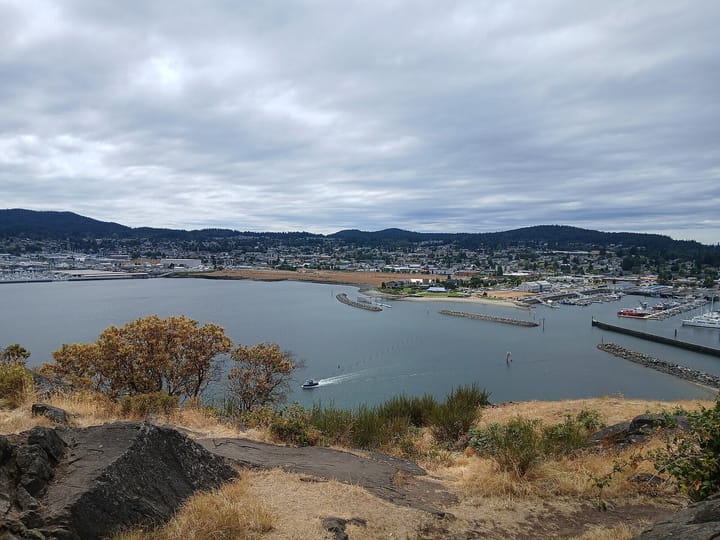
The songs are set in Anacortes, but Elverum has said he wasn’t trying to promote the town: the place is where the songs happen, not what they are about. The lyrics stay with small things anyway, like smoke from the fireplace and the car, mountains and websites in the same line, or a rainy day indoors until dusk. Not every critic was won over. Some found it distant, and one review heard the last three songs fall flat.
Fourteen years on, Clear Moon reads differently. Castrée, his wife, died in 2016, and A Crow Looked at Me, the album he made after, turned the same close attention on grief. Here that attention is still pointed at weather and hills. Paired with Ocean Roar it is the fuller statement, but on its own it is the more patient record, and the best way into Elverum’s work after the Microphones.


