Emily Reo grew up in Orlando taking piano and voice lessons, has also lived in Boston, Los Angeles and Montreal, and is based in Brooklyn. She had been releasing vocoder-laced pop on small artist-run labels since Minha Gatinha, a home-recorded debut from 2009, and her second album, Olive Juice, came out on Elestial Sound in 2013. Only You Can See It, her third, arrived on Carpark on 12 April 2019: ten songs, just under 37 minutes. In between she spent five years writing, recording, arranging, producing and mixing it herself, with time away from music during a period of poor mental health. She calls herself a perfectionist.
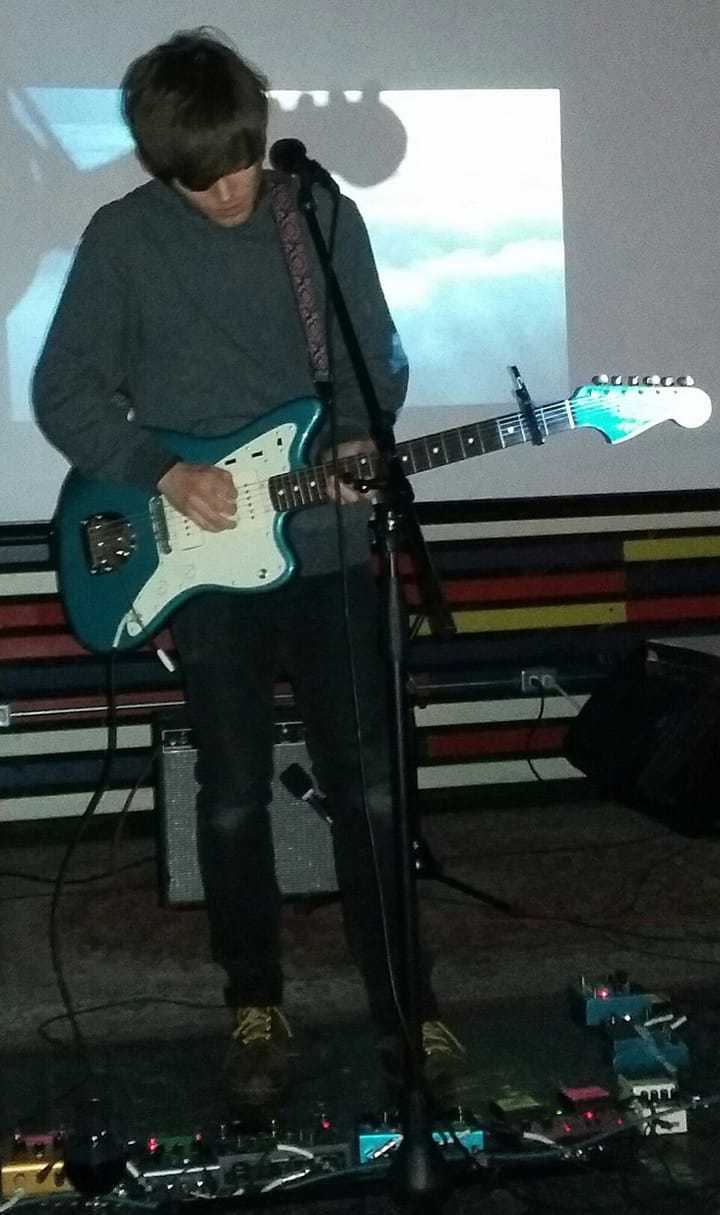
By her own estimate it is about 75 percent homes and 25 percent studio. She sketched parts with MIDI soft synths and then replaced many of them with a Juno-60, which she says is all over the record, plus her old Casio MT-100, an Omnichord, a Farfisa organ and piano. She recorded the vocals alone in empty houses that friends lent her. The studio share came from Gravesend Recordings in Brooklyn, where Julian Fader of Ava Luna and Carlos Hernandez tracked drums, organ, percussion and some of the bass and synth. For the first time she filled the songs out with a live band: Jack Greenleaf on bass, guitar, piano and omnichord, and Felix Walworth of Told Slant on drums, percussion, harp and theremin. Warren Hildebrand of Foxes in Fiction adds guitar, and Emily Lazar mastered it at The Lodge.
The subjects are heavy. “Ghosting” is, in her words, about depression, anxiety and OCD, and feeling “unable to live even though I was alive”. “Counterspell”, the shortest track at two minutes, reuses the vocals of her 2016 single “Spell” to reverse what that song described. “Phosphenes” opens the record with clapping that NPR compared to a patty-cake game, under her processed voice. Then side two opens with “Strawberry”, the lead single from January, a list of everyday sexism that includes being asked at load-in whether she is somebody’s girlfriend, with a chorus that spells out N-O-T-H-I-N-G and R-E-S-P-E-C-T.
The rest widens the frame. “Candy” is sung from the point of view of someone falling in love with a machine, a song about closeness through screens. “Balloon” is about self-reliance across several relationships, and Stereogum heard pitch-shifted vocals over pattering drums. “Charlie” mourns her cat, down to the hair on the carpet and wearing his ashes. The closer, “In Theaters”, supplies the title and the idea behind it: people alone in cinemas, watching their own lives where nobody else can see them. Her best friend, Jaclyn Miller, drew the cover, curtains opening on a night scene, and laid out the lyrics inside the gatefold like a comic.
Critics were warm and close to unanimous. Pitchfork’s Madison Bloom gave it 7.8 and called it “a sprawling opus from a pop polymath”. NPR streamed it as a First Listen, Stereogum’s James Rettig thought it sounded impeccable, and Bandcamp Daily made it Album of the Day. Glide and New Noise both dwelt on the gap between the bright sound and the dark subjects. None of them found much to fault. They differed mainly in the comparisons: Pitchfork reached for Grimes’ Art Angels, Glide for Imogen Heap and Tegan and Sara, New Noise for Britney Spears.
That gap is the record’s argument, and the way it was made backs it up. One person wrote, produced and mixed these songs over five years, then filled them out with a live band for the first time, and she set subjects as heavy as illness, harassment and a dead pet to songs she says she built to be earworms. At ten songs and under 37 minutes, it does not overstay. Her next release was a single, “One Eye on the Sky”, sold through Bandcamp in June 2020 to raise money for The Okra Project and the Marsha P. Johnson Institute.
Watch and listen
Players only load when you press play. Their providers may set cookies.


