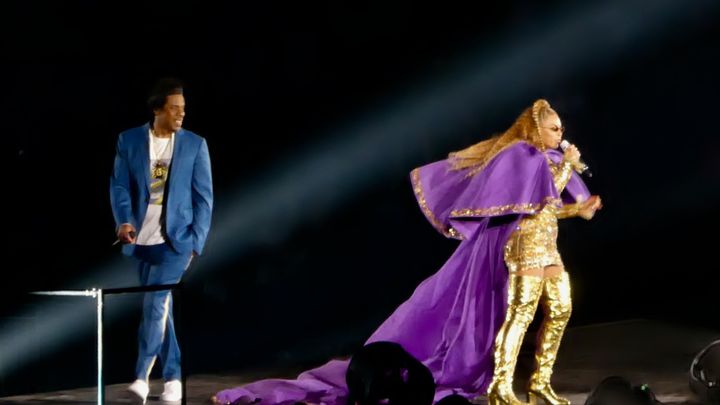
The Carters released Everything Is Love on 16 June 2018, at the end of their second London Stadium show on the On the Run II Tour: the “Apeshit” video played on the stage screen, followed by “Album out now”. It went up on Tidal, then Jay-Z’s streaming service, and everywhere else two days later. Critics heard the couple’s first joint album as the end of a trilogy that began with Lemonade (2016) and 4:44 (2017), the solo albums on which she addressed and he acknowledged infidelity in their marriage. In 2017 Jay-Z had told the New York Times that they were “using our art almost like a therapy session”, and that Lemonade came out first because her songs were further along.
Much of it was made in Paris while the couple rehearsed the tour at the U Arena, where, Cool & Dre told Rolling Stone, the owners’ suites became studios overlooking the stage. A week in Cardiff, where the tour opened, largely finished it, and parts were still being recorded an hour and a half before the last London show. The Carters share production credits on all nine tracks with Pharrell Williams, Boi-1da, D’Mile, Dave Sitek of TV on the Radio and Cool & Dre, who did more than anyone but the couple. Stuart White, the main engineer, told Sound on Sound he recorded both through one microphone chain because they swapped at the mic all day. As the Guardian and the Observer noted, Beyoncé raps far more than she sings.
The first and last songs carry the marriage. “Summer”, built from a sampled passage of late-1960s-style soul, with strings added at the couple’s request and arranged by Derek Dixie, is one of the few places Beyoncé simply sings, and Jay-Z’s verse, the Guardian noted, turns from romance to violent summers in the Marcy Houses, where he grew up. “LoveHappy”, produced with Sitek, is the one song to return to the infidelity directly, as they trade lines about splitting up, reuniting and renewing their vows. The songs in between change the subject. “Apeshit” is a Pharrell beat with ad-libs from Quavo and Offset, then two of the three members of Migos; its video, shot in the Louvre by Ricky Saiz, supplied the cover. On it Jay-Z says he turned down the Super Bowl halftime show and mocks the Grammys for sending him home empty-handed from eight nominations.
“Boss” puts what the Guardian called a “spectacular 70s soul horn arrangement” under Beyoncé rapping about wealth that already reaches her great-great-grandchildren. “713”, named after Houston’s area code, has her singing a reworked hook from Dr. Dre’s “Still D.R.E.”, a hook Jay-Z wrote; “Heard About Us” reworks the Notorious B.I.G.’s “Juicy”; “Friends” is a roll call of Jay-Z’s inner circle. “Black Effect” opens with a woman’s spoken definition of love and names Trayvon Martin and Kalief Browder. Cool & Dre built it on a sample of Flower Travellin’ Band’s “Broken Strings” and, when Jay-Z asked for more bounce, gave it a trap feel.
Most reviews were warm. In Pitchfork, Briana Younger heard the trilogy resolved, with survival and riches celebrated together and Beyoncé outshining her husband as a rapper. Tara Joshi gave it four stars in the Observer but found it less about the marriage than about stability and money, a polished front rather than an account of reconciliation. Alexis Petridis, at three stars in the Guardian, found the boasting duller than the relationship songs, if usually witty, and felt the finale made the trilogy look like brand management. Tiny Mix Tapes, at one and a half stars, heard publicity for its makers’ lives and called their fixation on wealth its dullest part. It opened at No. 2 on the Billboard 200, where Lemonade and 4:44 had both debuted at No. 1, and won the Grammy for Best Urban Contemporary Album.
The bookends earn their praise, as does Beyoncé’s rapping. The trouble is the seven songs between them. A trilogy that started with Lemonade ends on stadium tours, a refused halftime show, the Louvre as a film set and a fortune measured in generations. Wealth on this scale is the album’s setting, and it rarely becomes its subject: the songs say how much there is and stop. “Black Effect” comes closest to arguing for something, and even there the uplift is counted in money. On “Nice” Beyoncé says she cares so little about streaming numbers that she kept Lemonade off Spotify; two days after the Tidal release, Everything Is Love was on Spotify.
Watch and listen
Players only load when you press play. Their providers may set cookies.


