Colin Stetson closed his New History Warfare trilogy in 2013, finished a tour with Bon Iver and found that ten years on the road had become, as he told PopMatters, “psychically and psychologically near unbearable”. The soul-searching started with one question: why make music this hard? The title of All This I Do for Glory, his first solo album since To See More Light, grew out of it. He wanted it to sound like a religious edict, and he says the story the record tells exposes the flaws in it. It came out on 52Hz on April 28, 2017: six pieces, 43 minutes, all played live with no overdubs or loops.
The press notes describe the first half of a doomed love story modelled on Greek tragedy, about ambition, legacy and the afterlife, set between his 2015 duo album with Sarah Neufeld and the first New History Warfare. Stetson called it the first of two character studies from one narrative. It is also the first record he made entirely alone. He plays alto, tenor and bass saxophones and contrabass clarinet, and he engineered, mixed and produced it himself, with additional mixing by Eli Crews and mastering by Mell Dettmer. With nobody else’s schedule to keep, he could spend five days playing one piece into different microphones to learn which caught which sound, and on many songs he did.
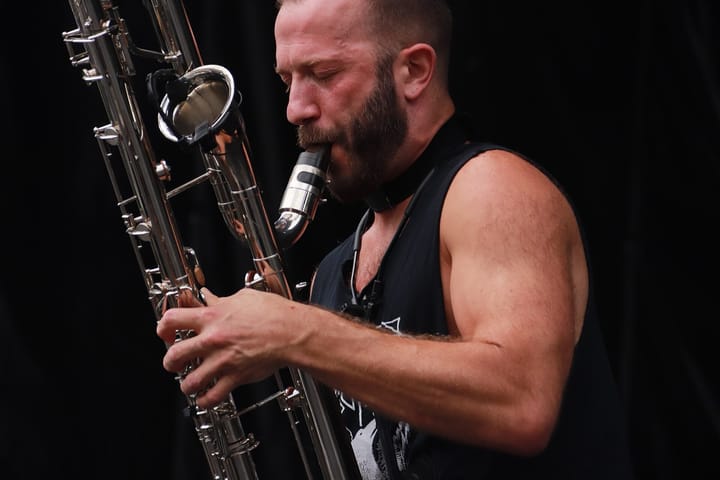
The microphones are where the record changes. The press notes promise “more invasive and thorough miking”. Stetson credits Enya’s Shepherd Moons with making him think about air: he set microphones inches from his face on both sides to pick up the breath through his nose, and used venting, letting air slip out at the corners of the mouth, something “sax and clarinet players are taught not to do in school”. He then swept that sound from one side of the stereo field to the other. Aphex Twin’s Syro pushed him towards the saxophone’s percussive side, the beats tapped out on its keys, and he said most of the new songs follow the rhythmic minimalism of 1990s electronica.
The songs carry the traces. The A.V. Club heard an early-’90s IDM breakbeat in the title track. “Between Water and Wind” was the first song he recorded; mixing it a month later while doing yardwork to Led Zeppelin III, he realised the groove was basically “Immigrant Song”. “Spindrift”, the first single, came with a video shot from inside the horn and close on his fingers, and Stetson set it against the second single, “In the Clinches”, the shortest track at 2:47: “Whereas ‘Spindrift’ is serenity and expanse, ‘In The Clinches’ is violence and immediacy.” He wanted that one to sound as if the listener were inside the instrument, and its video was shot the same way. The closer, “The Lure of the Mine”, runs 12:59 and took longest to write, built on a finger pattern so hard on the tendons of his right forearm that he had to work it into his daily practice.
Critics were mostly won over, and Metacritic’s average settled at 80. Drowned in Sound and Exclaim! gave it 10 out of 10; Exclaim!‘s Peter Ellman found it his most accessible record because of its rhythmic weight, and the A.V. Club heard a warmth the trilogy lacked. Several reviews singled out the close miking. The dissent was about novelty. Pitchfork’s Jayson Greene, at 7.1, wrote that it “doesn’t offer a single new idea”, compared it to a greatest-hits set and heard “Spindrift” as a relief. The Skinny found its darkness made for a tricky listen, and The Wire came away impressed but unmoved. PopMatters later ranked it second among the year’s experimental albums.
Both camps have a point, and the difference is time. Nothing here arrives quickly. The pieces work by repetition and small variation, which PopMatters compared to ritual music, and the press notes themselves speak of “a deepened sense of patience”. Greene is right that the techniques are ones Stetson had already used across the trilogy. What changed is the capture: breath, venting and keys recorded from inches away, by a man with all the time he wanted. The record takes its time and asks for yours, and it pays back in detail rather than surprise. Its last 13 minutes rest on a pattern that, when he started, he couldn’t play for more than a minute.
Watch and listen
Players only load when you press play. Their providers may set cookies.


