S U R V I V E finished their second album in January 2015, six months before the Duffer brothers got in touch to ask whether they were still a band. The brothers had used “Dirge”, from the Austin quartet’s first LP, in a mock trailer for a series they were pitching. By the time RR7349 came out on Relapse on September 30, 2016, two of the four, Kyle Dixon and Michael Stein, had scored that series, Stranger Things, and the album arrived as the follow-up to a hit it had nothing to do with. Like every S U R V I V E release, it is named after its catalogue number. The cassette, on Holodeck, the tape label Adam Jones co-founded, is called HD037.
The delay was about finding a home. Timmy Hefner, who runs the Austin punk and metal festival Chaos in Tejas, had the album sitting around and passed it to Relapse, a label known for metal. Dixon’s reasoning was simple: “why not get our album in front of a million people who wouldn’t hear it otherwise?” The band recorded it themselves in their own studios. The sleeve credits the recording to all four and the production to Stein, the member who usually handles engineering. There are no fixed parts. Everyone plays synthesizers, each member has a studio of his own, and a song usually starts with one or two of them before the rest finish it.
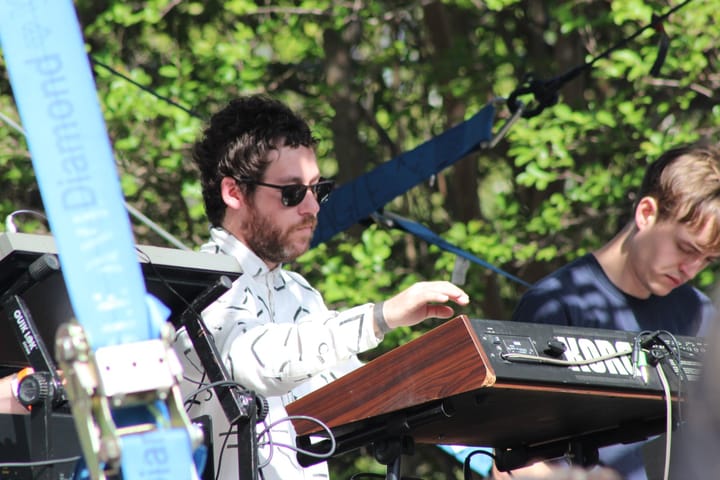
“Copter”, the longest track at 6:36, shows how that works. It began at Dixon’s house with a drum pattern he had been working on for a while. Mark Donica started turning the decay up and down on Dixon’s Korg Mono/Poly, and that became the bassline. “Wardenclyffe”, the second single, opens on a 4/4 kick, a distorted snare figure and a plain synth bass that turns into arpeggios, and NPR traced a drum break and a modulating pad into its climax. “A.H.B.”, the opener and first single, spends about 20 seconds on noise before the pulse arrives; the Austin Chronicle compared it to an asteroid plunging toward Earth. “Sorcerer” shares its title with William Friedkin’s 1977 film, whose Tangerine Dream score Stein has named among the band’s favourites.
The rest of the detail comes from critics, who agreed on more of it than usual. Two of them reached for a laser gun to describe the synth line in “Dirt”, and AllMusic noted whipcrack echoes trailing its drums. “Cutthroat”, the closer, was Pitchfork’s pick, built from arpeggiated squelches that deep bass and chimes slowly fill in. AllMusic also picked out soft washes of vocoder-masked voices on several tracks, the only voices on an otherwise instrumental record. The “Copter” video, directed by Chris Rusch and shot in Austin, Los Angeles and Croatia, sets the band playing in a dim room against drone footage.
The reviews were warm, and Metacritic’s average came to 81 from 12 of them. AllMusic called it the band’s most accomplished work, Pitchfork gave it 7.4 and praised the way it builds a narrative without words, and Exclaim! likened it to a book in chapters. The album reached No. 108 on the Billboard 200. The doubts were about what holds the moods together. Now found no memorable melody and heard “a suite of discrete moods”. Pretty Much Amazing noticed that nearly every track follows one plan: a burst of synths and drums, a breakdown two-thirds of the way in, a long outro. Even Spectrum Culture, which liked it, said it flows like “a soundtrack without a film”.
The band have said as much themselves. Before Stranger Things, Donica recalled, audiences complained the music was “cinematic but there’s no movie playing”, and Jones said people needed a sci-fi show to find the context for it. RR7349 is carefully made and full of good parts, like a bassline found by twisting a decay knob or a drum break placed to set up a climax. Most of it is pleasant rather than gripping, and it keeps pointing at images it doesn’t supply. The best case for it is the “Copter” video, which adds the drone shots and the dark room that the music on its own leaves out.
Watch and listen
Players only load when you press play. Their providers may set cookies.


